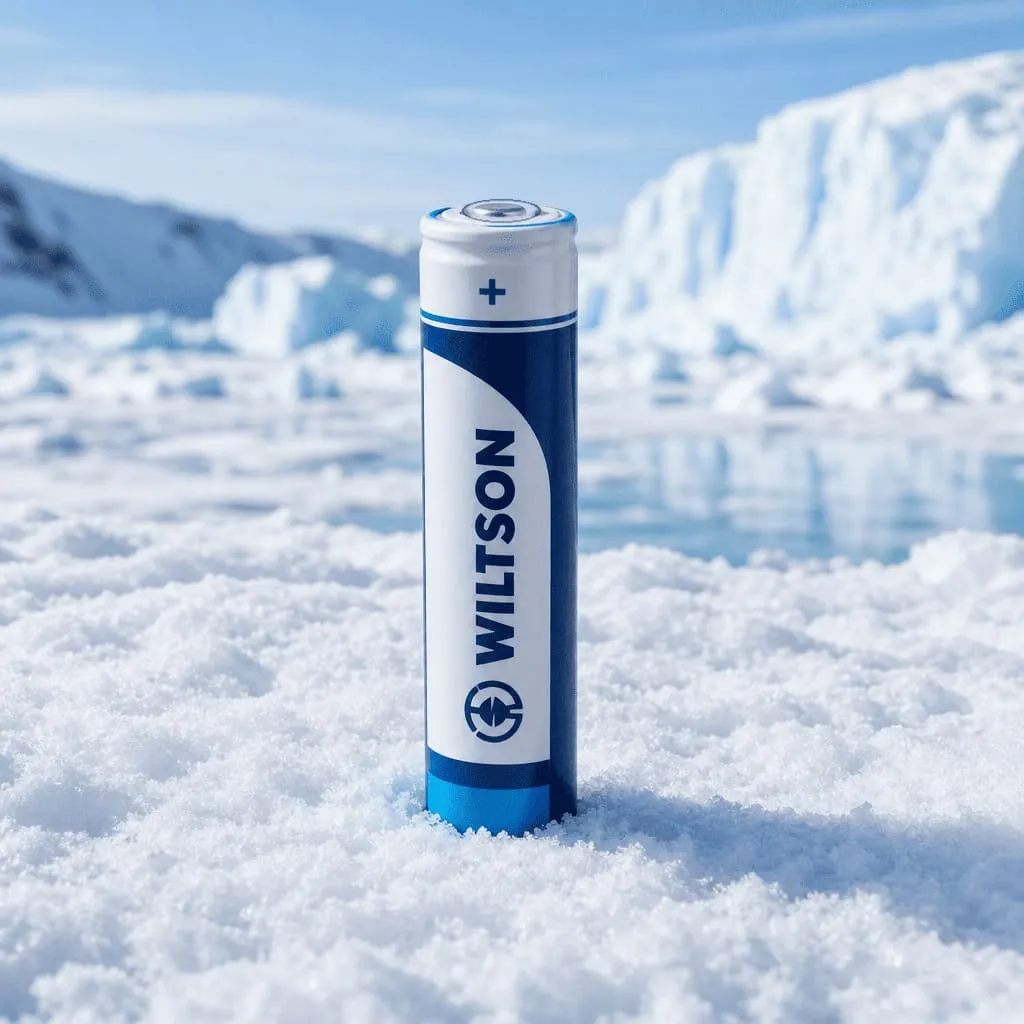
IFR18650 LiFePO₄ Cell: −50°C Discharge, 1500 mAh, No Thermal Event in Abuse Tests

TL;DR
- Discharge to −50°C, charge to −30°C — no external heater required (Wiltson Energy IFR18650 Product Announcement, May 2026)
- 1500 mAh nominal / 1400 mAh minimum @ 0.2C; 3.2 V; 128 Wh/kg; 3.0C max discharge in pack configurations (Product Announcement, May 2026)
- Seven abuse tests cleared — short-circuit, 10 A/10 V overcharge, 130°C thermal, drop, vibration, temperature shock — all with no fire, no explosion, no leakage (Product Announcement, May 2026)
- Standard 18650 form factor (18.3 mm × 65.3 mm, ≈42 g) for drop-in pack integration
- Before you specify: capacity retention at low temperature, charge derating curve, and cycle life are not in the announcement — request the datasheet
The trade-off hiding in the energy density number
128 Wh/kg puts the IFR18650 in the middle of the LiFePO₄ pack. NMC 18650 cells hit 200–250 Wh/kg. On energy density alone, the IFR18650 loses.
That ranking reverses below −30°C.
At sub-zero operating temperatures, energy density stops being the design constraint. The question becomes simpler: does the cell deliver rated current at all? Standard 18650 cells — NMC included — lose 30–50% of their capacity below −20°C as electrolyte viscosity climbs and internal resistance spikes. The IFR18650 is built to avoid that collapse. LFP chemistry, extended temperature window, standard form factor. The specification is straightforward.
Whether it fits your project depends on four figures the product announcement doesn't publish. I'll flag those gaps explicitly below.
What the published specification confirms
Every figure below traces to the Wiltson Energy IFR18650 product announcement (May 2026). Request the full datasheet for complete characterization curves before specifying in production.
Source: Wiltson Energy IFR18650 Product Announcement, May 2026
| Parameter | Value | Source |
|---|---|---|
| Chemistry | LiFePO₄ (LFP) | Product Announcement, May 2026 |
| Form factor | 18650 cylindrical | Product Announcement, May 2026 |
| Nominal voltage | 3.2 V | Product Announcement, May 2026 |
| Nominal capacity | 1500 mAh (@ 0.2C) | Product Announcement, May 2026 |
| Minimum capacity | 1400 mAh (@ 0.2C) | Product Announcement, May 2026 |
| Energy density | 128 Wh/kg | Product Announcement, May 2026 |
| Max continuous discharge (in packs) | 3.0C | Product Announcement, May 2026 |
| Charge range | −30°C to +45°C | Product Announcement, May 2026 |
| Discharge range | −50°C to +60°C | Product Announcement, May 2026 |
| Diameter | 18.3 ± 0.2 mm | Product Announcement, May 2026 |
| Height | 65.3 ± 0.5 mm | Product Announcement, May 2026 |
| Weight | ≈42 g | Product Announcement, May 2026 |
Key Insight: The announcement gives capacity at 0.2C room temperature. It does not publish capacity at 0.5C, 1C, or any sub-zero temperature. For cold-climate applications, this is the critical missing figure — your BMS must size headroom around it.
The temperature window is asymmetric — and that matters
Discharge extends to −50°C. Charge stops at −30°C.
That 20°C gap between the charge floor and the discharge floor has real engineering consequences. In Nordic winters, a vehicle or sensor parked overnight at −35°C can still discharge the battery — but cannot accept a charge until the enclosure warms above −30°C. Design your charge controller logic accordingly.
Source: Wiltson Energy IFR18650 Product Announcement, May 2026
| Operation | Min | Max | Engineering note |
|---|---|---|---|
| Discharge | −50°C | +60°C | No heating element required |
| Charge | −30°C | +45°C | Must derate current below 0°C — derating curve not published |
Non-negotiable: Do not charge below −30°C. Below 0°C, reduce charge current — the exact derating curve is not in the announcement and must be requested from Wiltson Energy before BMS development. I've seen projects where engineers assumed "charge rated to −X°C" meant "charge at full rate to −X°C." The cells were destroyed within two winters.
The +60°C discharge ceiling covers most industrial enclosures. Verify your thermal model for desert or high-ambient deployments.
Seven safety tests. One result repeated seven times.
LFP chemistry carries a structural safety advantage. The olivine crystal lattice resists oxygen release on thermal breakdown — a mechanism that triggers the exothermic cascade behind thermal runaway in other lithium chemistries. The IFR18650's published abuse test results are consistent with this property.
Source: Wiltson Energy IFR18650 Product Announcement, May 2026
| Test | Condition | Result |
|---|---|---|
| Short circuit | External short at full charge | No fire, no explosion, no leakage |
| Overcharge | 10 A / 10 V applied | No fire, no explosion, no leakage |
| Over-discharge | Discharged below cutoff | No fire, no explosion, no leakage |
| Thermal abuse | Oven at 130°C | No fire, no explosion, no leakage |
| Drop | Impact test | No fire, no explosion, no leakage |
| Vibration | Mechanical vibration profile | No fire, no explosion, no leakage |
| Temperature shock | Rapid thermal cycling | No fire, no explosion, no leakage |
The 130°C thermal abuse test is the one to focus on. It simulates the temperature that other lithium chemistries approach during an internal fault or prolonged overcharge — a condition that triggers thermal runaway in NMC packs. The IFR18650 passes without a thermal event. That result matters most in multi-cell configurations where a single cell failure can propagate.
Common Mistake: Treating the abuse test results as certification. They are not. The announcement does not specify which testing standard was applied (UN38.3, IEC 62133-2, UL 1642, or in-house protocol). Request the test reports and certification documents before placing production orders for regulated markets.
When to specify the IFR18650 — and when not to
The decision framework is straightforward.
Specify the IFR18650 when:
- Your discharge environment reaches −30°C or below and active heating is not an option (weight, cost, or reliability constraints)
- Your application cannot tolerate a thermal event — medical devices, unattended field installations, marine enclosures
- Standard 18650 form factor is required for compatibility with existing pack tooling or battery management hardware
- Long cycle life matters more than maximum energy density — LFP chemistry preserves capacity over more cycles than NMC at equivalent usage
Do not specify the IFR18650 when:
- Weight or volume is the binding constraint in a temperature-controlled environment — NMC cells at 200+ Wh/kg deliver more energy per gram
- Your operating temperature never drops below −10°C and thermal runaway risk is managed at the pack level — standard LFP may be sufficient and less expensive
- You need a certified cell for a regulated market and the IFR18650's certification status cannot be confirmed before your design lock date
Data gaps: what to request before you specify
The product announcement establishes the temperature operating range and the abuse test outcomes. Four critical figures are missing. Specifying the IFR18650 into a production BOM without these numbers is a known risk.
- Capacity retention at sub-zero temperature — What is the usable capacity at −20°C, −40°C, and −50°C at your target discharge rate? This determines real-world runtime, not the 1500 mAh room-temperature rating.
- Charge derating curve — What is the maximum safe charge current at 0°C, −10°C, −20°C, and −30°C? Your BMS firmware must enforce this limit or lithium plating will degrade the cells.
- Cycle life — How many charge-discharge cycles before capacity drops to 80%? At what temperature was the cycle life tested? LFP cells typically show reduced cycle count at low temperatures versus room-temperature baseline.
- Certification documentation — Which specific standards were tested (UN38.3, IEC 62133-2, UL 1642)? This determines which markets and transport routes are available for products using this cell.
Conclusion
The IFR18650 addresses a specific problem: a standard-format 18650 cell that operates below −30°C without a heating subsystem, built on LFP chemistry with a clean abuse test record.
The product announcement confirms the temperature window and the safety test outcomes. It does not confirm capacity at low temperature, the charge derating curve, or cycle life.
The engineering decision depends on those missing numbers. Request the datasheet, run your own validation cycle on samples, then specify.
FAQ
What capacity does the IFR18650 deliver at −40°C or −50°C?
The product announcement confirms discharge to −50°C but does not publish capacity retention figures at sub-zero temperatures. This is the first number to request from Wiltson Energy before specifying the cell. Ask for the test report showing capacity at −20°C, −40°C, and −50°C at your target discharge rate. Do not size a pack around the 1500 mAh nominal figure if your operating temperature goes below −10°C. (Wiltson Energy IFR18650 Product Announcement, May 2026 — data gap flagged)
What is the safe charge current below 0°C?
The operating window shows charging down to −30°C, but the announcement does not publish a charge derating curve. This is non-negotiable for BMS design. Before writing BMS firmware, request the full derating table: maximum charge current at 0°C, −10°C, −20°C, and −30°C. Charging above the safe rate at sub-zero temperatures causes lithium plating — irreversible anode damage that won't appear until the second or third winter. (Product Announcement, May 2026 — data gap flagged)
What is the cycle life of the IFR18650?
Not stated in the product announcement. Request cycle life at both 25°C baseline and your operating temperature before writing a system specification. For LFP cells generally, low-temperature cycling shortens cycle life compared to room-temperature operation — the IFR18650's specific figures require verification from Wiltson Energy's test reports. (Product Announcement, May 2026 — data gap flagged)
What certifications does the IFR18650 hold?
The announcement references "rigorous testing" and an ISO-certified facility but does not name specific standards. For European markets, verify IEC 62133-2 or UN38.3. For North American markets, verify UL 1642. Request the full certification documentation from Wiltson Energy before placing volume orders — shipping lithium cells internationally without proper transport certification triggers customs holds. (Product Announcement, May 2026 — data gap flagged)
Why does the IFR18650 lose on energy density versus NMC 18650 cells?
LFP chemistry trades energy density for thermal stability and cycle life. At 128 Wh/kg, it sits below NMC at 200–250 Wh/kg. The trade-off is structural: LFP's olivine crystal lattice resists thermal decomposition at temperatures that destabilize NMC cathodes, which eliminates thermal runaway risk. For weight-critical applications in temperature-controlled environments, NMC stays competitive. For cold-climate deployments where a thermal event in the field has real consequences, LFP wins. (Product Announcement, May 2026)
Can I mix IFR18650 cells with standard 18650 cells in the same pack?
No. Never mix chemistries, capacities, or batch ages in a pack. LFP's 3.2 V nominal differs from NMC's 3.6–3.7 V — mismatched chemistry destroys pack balance and causes BMS protection trips. Design your pack around matched cells from the same batch and same production lot. (General engineering requirement; verify BMS thresholds against IFR18650 voltage curves before production.)
Next Steps
Evaluating the IFR18650 for your pack design?
Wiltson Energy's engineering team can provide:
- Full datasheet with capacity curves, internal resistance, and cycle life data
- Charge derating table for BMS firmware development
- Sample cells for independent characterization and pack qualification testing
- Certification documentation for your target markets
- Volume pricing and lead times for production planning
Contact Wiltson Energy:
- Email: sales@wiltsonenergy.com
- Tel: +86-769-8100-7293
- Location: No.3 Nengda Road, Shipai District, Dongguan, China
No commitment required. Samples available for qualified OEM projects.